


My question sounded like the title of a Marvel superhero movie. But the people who joined the conversation refused to pick a winner.
But let’s rewind for a moment. (Imagine that classic movie rewind effect.)
It actually all started with a completely different question.
How did we get here?
It started with something I felt was missing from AI: the ability to organize all my conversations into a structured, searchable database. For me, it was also about something I wanted to delegate. But Dont stop the beat., one of the readers, showed me just how much more there was behind this seemingly simple missing feature.
During our conversation, they actually suggested a way to solve my problem. Or at least how they would approach it:
Try exporting your threads to PDF and store in NotebookLM maybe.
And then came another option:
I could build an agent to do this task, but the design to minimise API calls would take time and interest.
And that’s where things got interesting for me.
A third option enters the game.
Historically, users have had two options.
Option 1:
Find a manual workaround for the limitations of existing tools. Export something here, reorganize something there, put it all into a spreadsheet.
That’s probably one of the reasons Excel is still so popular. I’ve even seen cases where it completely replaced Jira.
Option 2:
Use an existing SaaS product that solves the problem for you.
But AI has introduced
Option 3:
Build your own custom AI agent.
And that’s where things get interesting. Now users can effectively build their own solutions, indirectly competing with existing SaaS products.
Watch out, SaaS developers!
So I asked my subscribers a question:
Custom-built AI agents vs. digital products. Who wins?
And here’s what I learned.

First, it’s not a choice between just two options.
The spreadsheet is still on the table. Oli pointed out that people used to want the spreadsheet. Now they want the agent that fills it in.
And there are other options, too.
Like autonomy. Not allowing technocrats to control people. Well, the comment was actually much more specific about what exactly shouldn’t be allowed to control people. But my tone of voice won’t let me repeat it here, so I’ll leave you to read the original comment by SpaceJunkFireballs.
But jokes aside.
Second, the ability to build your own AI agents opens up a whole new set of questions.
And this is where the conversation became particularly interesting.
The cost of custom-built agents - Oli
nobody budgets for this: a product ships once, an agent needs a babysitter forever. most solopreneurs choosing “agent” are signing up for maintenance they never priced in
Reliability and specialization - Boldare
The product handles the boring, reliable part, and the agent takes care of whatever is specific to how your team works
The user’s workflow - Amar Pal Singh Bhalla
If the product already does the job well, why build an agent? But if you find yourself changing your workflow to fit the software, maybe the software isn’t the right fit anymore.
Use cases and the need for ongoing adjustments - bold opinions
This raised another question for me as a product designer: how will users navigate between different agents if they decide to build their own, or use a multi-agent system built for them?
Flexibility - How Machines Think
Another factor in deciding whether to use an existing product or build an agent.
Sensitivity - Monika
Whether an AI agent is even a reasonable alternative may depend on how sensitive the task is.
And each of these points opened up another conversation.


More questions than answers
Are people ready to pay for ongoing agent maintenance?
And what happens if we show them the full cost upfront?
Development time + maintenance + learning curve + debugging + human oversight and so on.
I’m still exploring what else I might have forgotten to include.
How do we account for the entire user workflow when building a product, rather than focusing on one specific task?
Oh, how I love this question.
From my experience as a product designer, this happens far too often. Products forget, or sometimes even ignore, the user’s actual workflow. And users end up either adapting their workflows to fit the software, cancelling their SaaS subscriptions, or building their own agents.
But the irony is that AI agents often have a similar problem. They might do one task really well, but struggle with what comes before and after it in the workflow.
Will managing multiple specialized agents become a UX challenge of its own?
Or will we simply have one interface coordinating everything behind the scenes?
Will custom-built AI agents compete with products in industries like fintech?
As Monika pointed out:
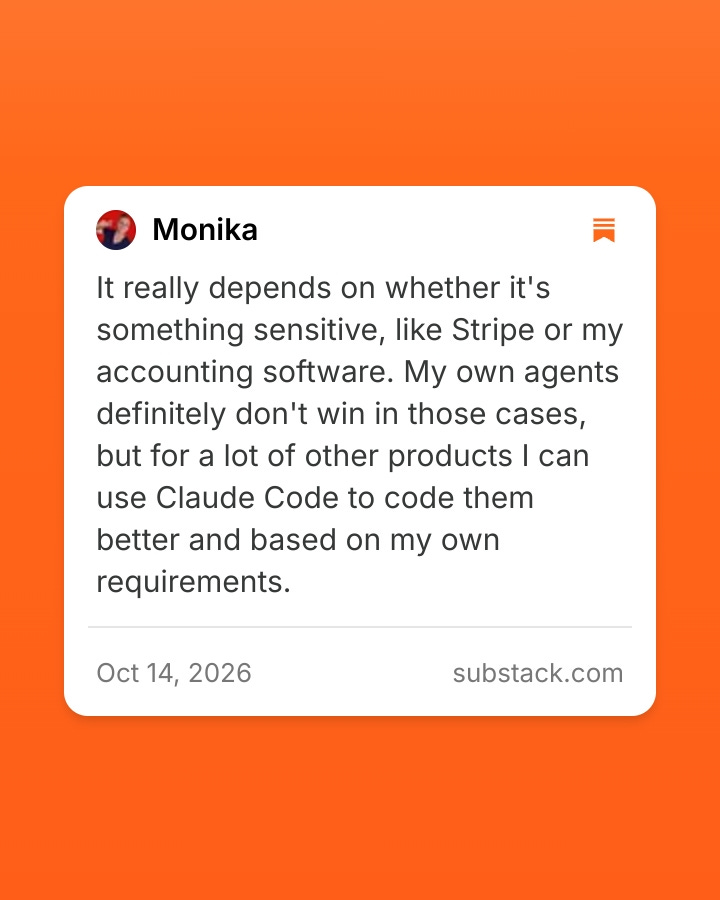
That raises another question about where existing products might have a competitive advantage.
So, who wins?
Perhaps it’s a good thing that “It depends” was the most popular answer.
Because this conversation raised more questions than it answered.
And now I have a whole new set of challenges to explore.
I’ll keep researching.
Stay tuned.
Thank you for taking part in this conversation:
Oli, jaycee, Monika, Amar Pal Singh Bhalla, bold opinions, Boldare, How Machines Think, Axel Plage, SpaceJunkFireballs
Special thanks to Dont stop the beat. for sparking this conversation.
Thank you.