



This month, October 2026, we’re focusing on AI adoption metrics in the AI Adaptation Lab. A few days ago, I shared one signal about AI adoption metrics going up while product satisfaction goes down.
Just an observation, not a point I was trying to prove. But it became the starting point for an interesting discussion you wouldn’t want to miss.
The people in this conversation
Me Tetiana Shevtsova with a background in product design and UX strategy, who started the conversation.
Haseeb Afsar - Head of Engineering at Yahoo.
Timur Tibeyev - Staff Software Engineer at Canva.
Arun K S - an AI skeptic with around 28 years of experience in software.
What was on the table?
What if we’re measuring the wrong kind of work?
Haseeb brought up a metric I hadn’t considered: rework rate. And probably most importantly, he pointed out that almost nobody measures it.
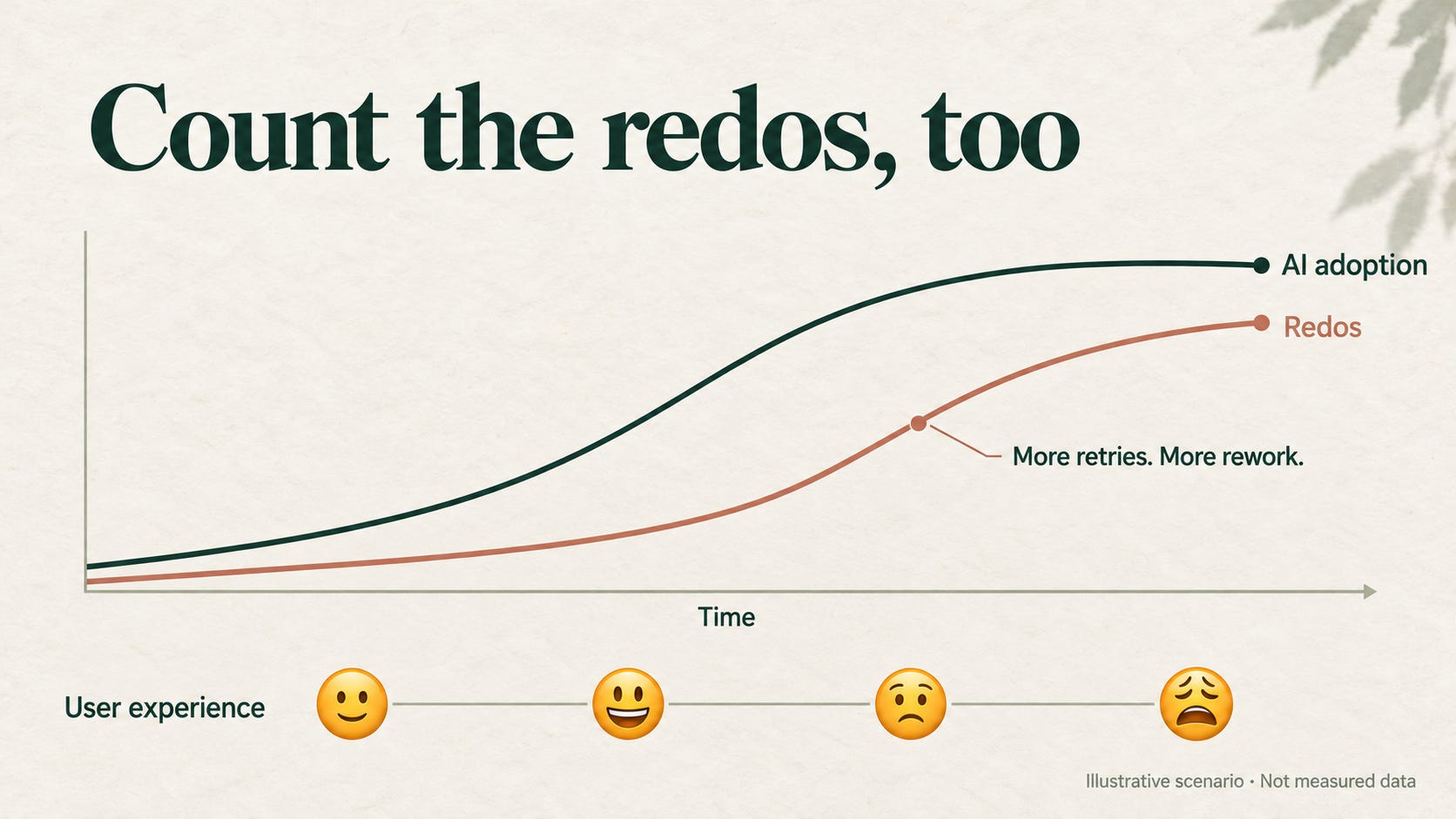
Interesting, right?
But it’s kind of expected that users won’t get the right result from AI on the first try. I’d say it happens somewhere between never and very rarely, at least.
So I challenged his idea and got an important distinction:
When in the process does the rework take place - before or after the output is accepted?
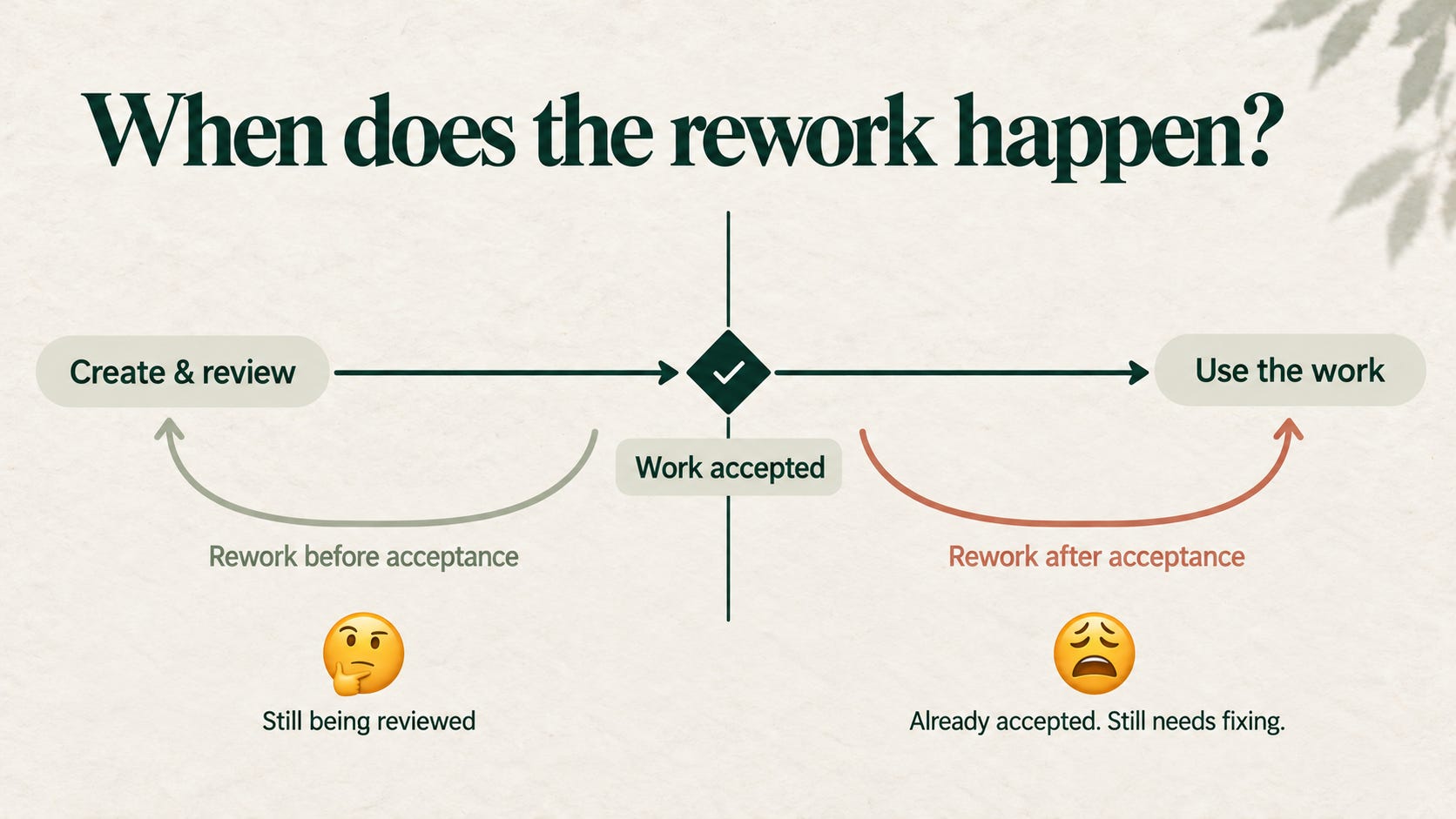
Haseeb’s suggestion was to count only the second:
Redo after it was accepted is the cost. Count only the second.
What I think is no less important in his comment is that dashboards rarely show this number.
Shouldn’t we be concerned about that?
Is reliability something we can fix?
The second perspective started with a concern about reliability.
But if I understood Timur Tibeyev, Staff Software Engineer at Canva, correctly, we ended up with three problems that, at this point in time, October 2026, still stand in the way:
Context limitations.
The cost of AI.
The adoption of AI throughout the software engineering process.
And until we address these problems, reliability will remain a challenge.
How long will that take? Nobody knows.
AI adoption or greenwashing?
The third perspective came from Arun K S, an AI skeptic with around 28 years in software.
Greenwashing.
That’s what he compared AI adoption to, because, in his opinion, AI is being adopted in too many cases where it wasn’t actually needed.
What’s missing from these conversations?
Emojis, honestly.
What do I mean?
I mean that when you look at the metrics we’ve discussed with the professionals above, you don’t really feel the users’ pain. And if we want to make better decisions, shouldn’t we consider that too?
Maybe emojis could help a little with that. But jokes aside, here’s where I’m going with this.
First, I’d really like to continue this conversation. I think it started in an interesting way and became even more interesting as it developed.
So why not keep it going?
What do you think? Let me know in the comments.
But since one of the goals of the AI Adaptation Lab is to propose experiments and observe AI in the wild to understand what survives and continues to grow, that’s exactly what I’ll be doing next.
I’ll be introducing practical experiments based on the questions we’re exploring here.
The practical part of the Lab launches this month.
Subscribe so you don’t miss it, and be among the first to experiment.
Adapt, not optimise.