

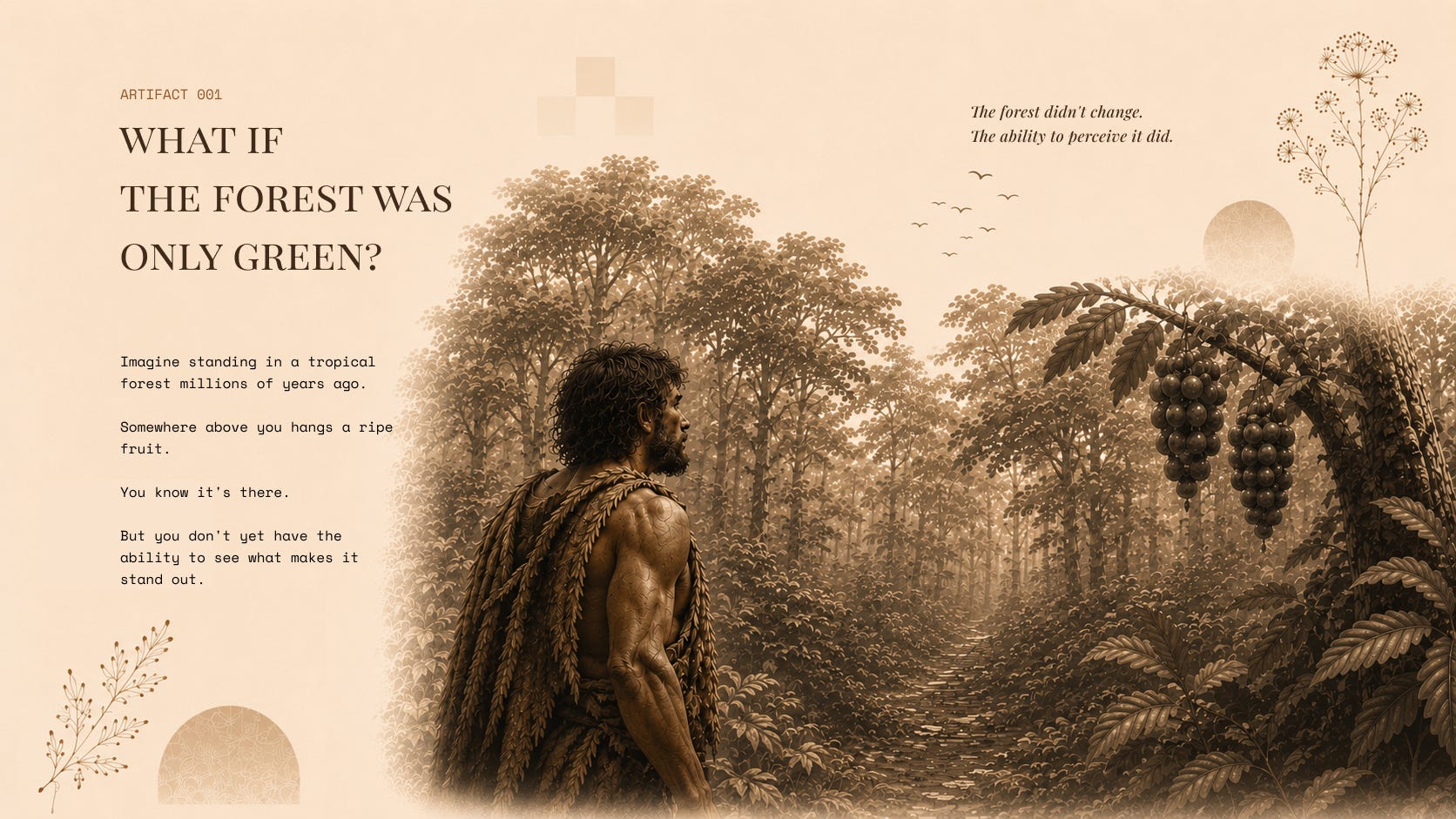
Imagine standing in a tropical forest millions of years ago. You’re hungry. Somewhere above you, hidden among the leaves, hangs a ripe red palm fruit. You know it’s there. You move closer, scanning the branches, trying to catch a glimpse of it before climbing the tree.
But stop. Let’s pause for a moment.
That isn’t actually what our ancestors saw. Evolutionary biologists believe early primates hadn’t yet developed the color vision most of us take for granted today. The fruit wasn’t red. Not to them.
The forest was a world of greens, yellows, light, shadow, and contrast. Finding food wasn’t simply a matter of looking in the right direction. It meant searching branch by branch, relying on shape, texture, smell, memory, and sometimes pure luck.
Then, over many generations, something remarkably small happened. A genetic mutation produced an additional photopigment receptor. For the first time, reds and greens became easier to distinguish. The fruit became easier to find. The forest hadn’t changed. What changed was the ability to perceive it.
That story stayed with me. Not because I was particularly interested in biology. Quite the opposite. Biology was never really my thing. Which is why I still find it slightly ironic that it ended up giving me the language I’d been searching for.
For months I kept noticing the same feeling during product work. Conversations had changed. Discovery had changed. Even the relationship between people and software felt different.
Yet every word I reached for felt slightly wrong.
Transformation.
Automation.
Disruption.
Evolution.
Each one described part of what I was observing. None of them described the whole picture. I wasn’t looking for a better metaphor. I was looking for better language. Then I remembered another question that had fascinated me for years.
For centuries, scholars have debated why Homer described the sea as wine-dark instead of blue.
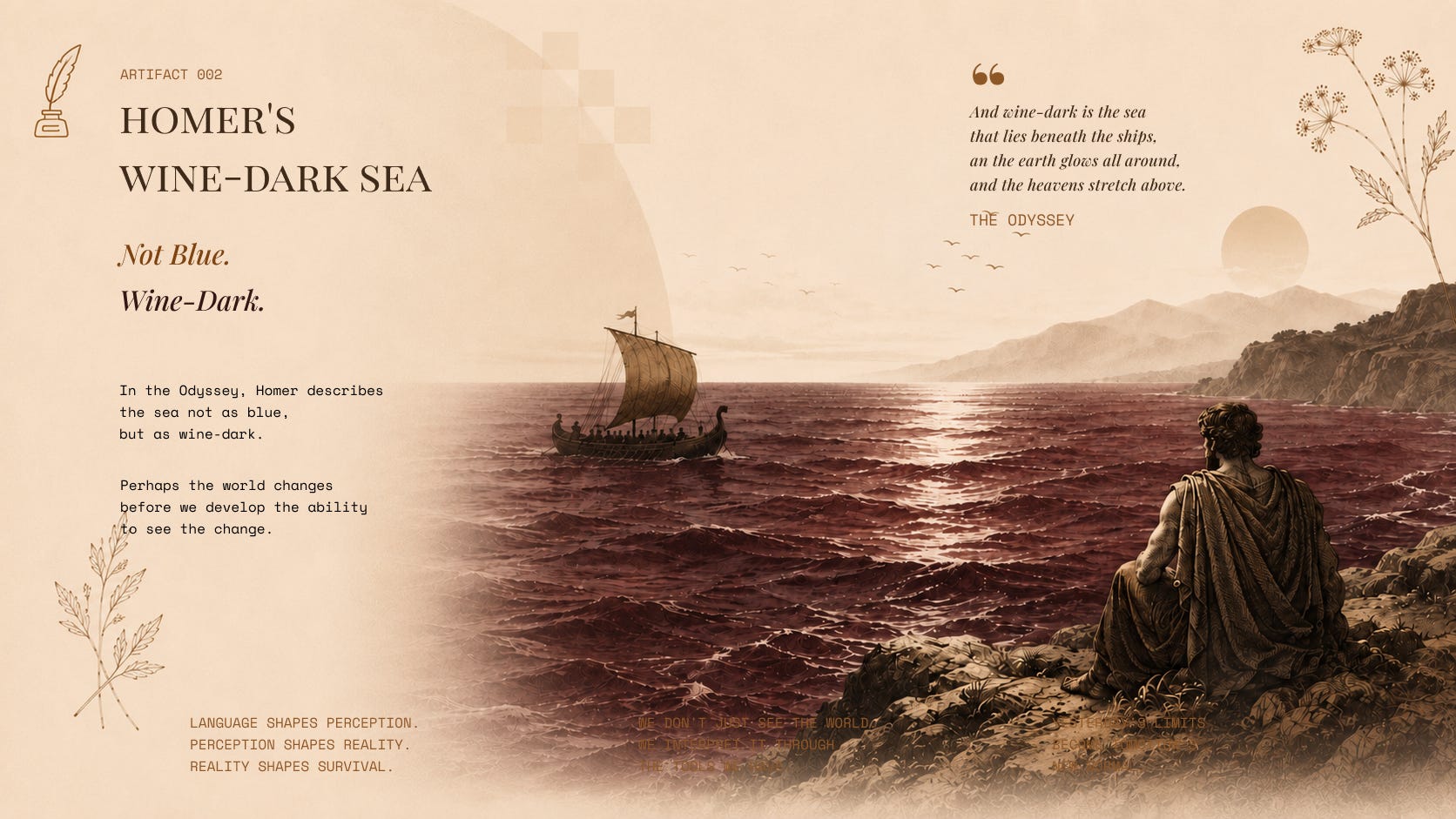
Was it language? Was it perception? Or was it simply a different way of experiencing the world? No one knows for certain. But the question itself stayed with me. How much of reality depends not only on what’s there…
…but on what we’re able to notice?
That’s when I realized I wasn’t searching for a better metaphor. I was searching for a better name.
Mutation.
Because, in biology, mutation is rarely the end of the story. It’s the beginning. A small change that quietly reshapes what becomes possible. That was the language I’d been looking for.
Not a metaphor.
A language.
A way to describe many of the changes I was beginning to observe across products, organizations, and the people building them. I eventually started calling it The Mutation Era. Biology had already developed a language for describing something I was struggling to name.
That idea eventually became the starting point for a book I’m writing called The Mutation Era. It’s an exploration of what happens when the environment changes - and everything inside it begins to adapt.