


This month, I’ve looked at two AI adoption cases for products I’ve considered to be home for my AI Adaptation Lab. They are, in a way, two very different platforms, but they have very similar audiences: coaches, community leaders, and writers.
But their history of AI adoption is completely different. I’d even say they couldn’t be further apart.
So, let’s take a closer look.

I ran both products through my AI Adaptation Framework. Here is what I found, and you’ll find out why I’m putting these two products in one article at the end.
First things first.
Structure
The first layer of my framework is Structure.
This is one of the most important things I look at when doing product audits, and I was doing this long before the AI adoption wave. Usually, when a product has been on the market for some time, structure is one of its weaknesses.
But if we look at Structure from the AI adoption perspective and compare Kajabi and Substack, we’ll find that Kajabi went the copilot route. Their copilot is called Cofounder, and it’s a chatbot that helps you start building something on Kajabi. Or rather, it can even build it for you. But more on that later.

If we talk about Substack, it’s a completely different approach. At first glance, it might seem that nobody really bothered with AI adoption there. But that’s only if you’re an author using the platform.
If you’re a reader, AI is there, although the discoverability of the feature isn’t exactly obvious.
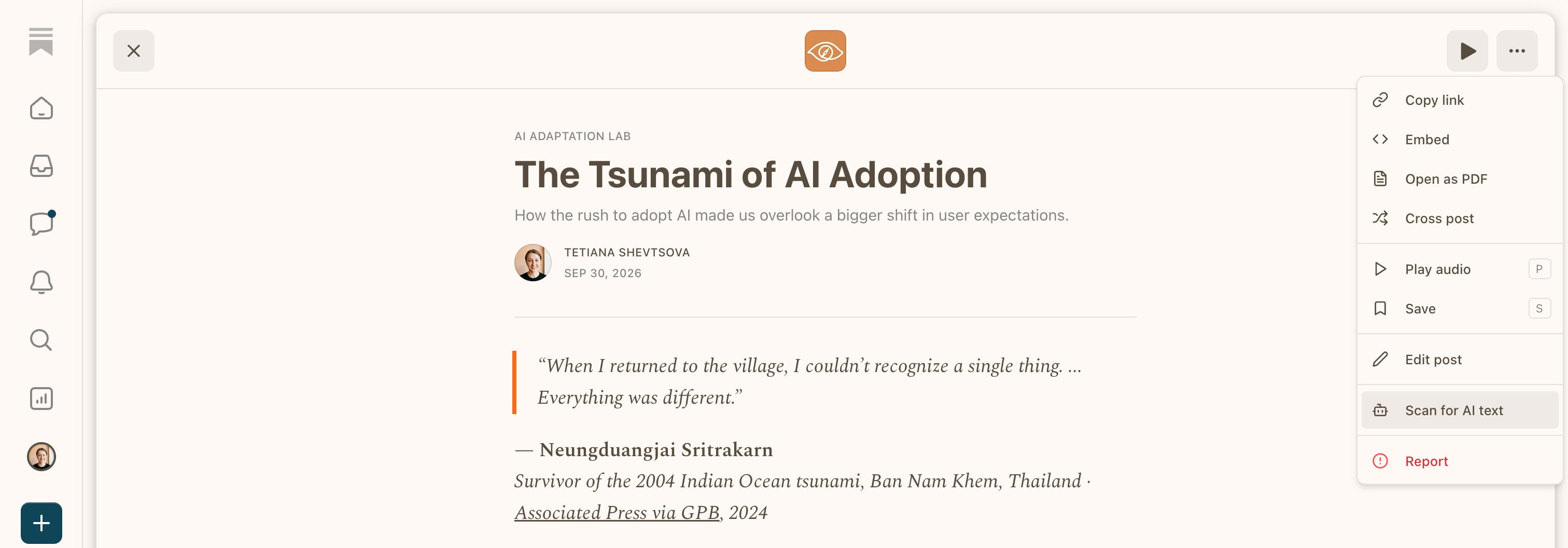
The feature is actually built for readers, but it isn’t added to navigation, as we often see with a sparkling AI icon. And the platform doesn’t really promote it directly to readers. It’s actually quite difficult to find if you don’t already know it’s there.
So what’s the point?
Many creators and writers on the platform have discussed this feature in the context of the hype around AI transparency. But in my opinion, there’s something much deeper here.
Because the creators on the platform could hardly miss this feature. Quite the opposite, they couldn’t help talking about it in their communities.
Delegation
Next, I analyze products through the lens of delegation. Level of Delegation. Delegation Criticality. But these two cases made me think about something else: Delegation Impact.
And here is why.
What do people who want to start a coaching business usually lack? Knowledge of how to set up a platform. Knowledge of how to create a marketing message. Knowledge of how to find clients for their educational products. And sometimes, simply time.
How critical are these tasks for launching such a business? High. I’d say the level of criticality is high. So Kajabi focused on giving users the ability to delegate these tasks to Cofounder.
It literally goes through a short questionnaire about your audience and idea, writes content for you, and creates landing pages and emails in the system. I would say that if we mapped the customer journey, like in the good old days when UX was a mandatory part of the process, we’d probably see a high level of satisfaction at this stage.
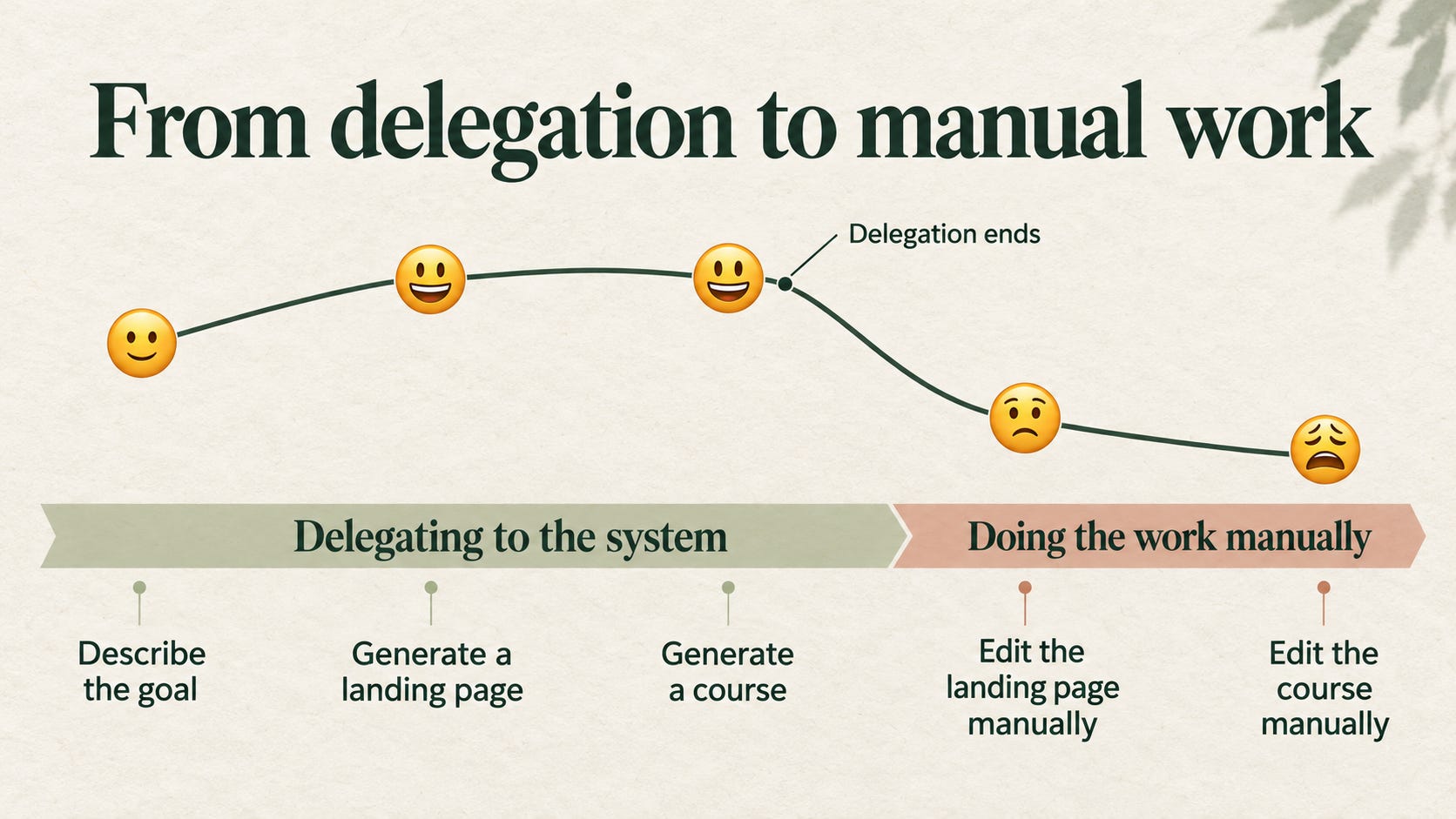
But most likely, we’d see a drop next. Why? Because the workflow is no less important than the feature itself. How often are people satisfied with what AI suggests on the first try? Those who work with AI adoption know that creating something with AI is easy. What is much harder, and often much more time-consuming, is editing what AI has created.
That’s the real skill.
In Kajabi, you have two paths.
Path one.
Continue using Cofounder, spend a lot of time trying to get the result you expect, and possibly never get there. So this is where product retention might drop. We might never see this user again, even though they’ve already used the AI feature and generated something.
They don’t know it, but the business is losing a customer.
Path two.
Go and manually edit the landing page, email, or whatever Cofounder created for you. And in this case, there is a chance the user will stay. But what’s the point if, at this stage, when the user is actively working on their product, they no longer have the advantage of using AI?
Of course, I’m talking about possible user behavior here, not actual Kajabi retention data. But it’s exactly what I would want to investigate.
Now, Substack.
What does the user delegate to the platform? Not writing articles. Not even editing. Authors delegate the creation of promotional materials for their articles and the ability to share them across different platforms.
But the more interesting feature, in my personal opinion, is Scan for AI text. Here, delegation happens too, but not for the author. For the reader. The reader delegates to AI the task of checking whether the content was written by AI or a human.
Is this a critical task for the user? Probably not, I’d say. But I couldn’t stop wondering why they added it. And then, when I sat down to write my next article, I ran it through the AI detector and realized something.
I wanted it to show that my writing was human. Of course, I use AI, like many other authors, for research, translation, and so on. But in this case, something clicked.
I realized that the feature motivated me to make my writing more authentic. To use my own words rather than accepting AI-generated formulations. And that’s when I understood that there was something else very important here.
Delegation isn’t enough if we don’t think about impact.
What impact does this feature have? It motivates authors to create more authentic content, which could contribute to reader satisfaction with the platform over time. At least, that’s what happened in my case.
And the interesting thing is that the feature isn’t even designed for me as an author. It’s designed for readers. Of course, AI detection isn’t a reliable measure of whether writing is authentic. But the fact that this feature influenced my behavior as an author made me think.
Delegation Impact
Kajabi went the route of giving users the ability to delegate time-consuming tasks. Substack went a different way. Through a feature for readers, it may influence the people who actually make the platform what it is: authors.
And that brings me to the question of impact.
What impact does delegation have on overall satisfaction with the product? Because it’s not necessarily only about the value AI creates for the person directly using the feature. Sometimes it can affect someone else.
And in Substack’s case, it might even affect the experience of readers who never use AI detection themselves. That’s why I think Delegation Impact is something we need to consider alongside Level of Delegation and Delegation Criticality.
Which approach do you think is more forward-looking and has a greater impact on overall user satisfaction with the platform?
Growth and Scale
AI adoption, and the way it’s implemented, affects product growth and scale. That’s why Scale is another layer of my framework. I could talk about the other layers in this article, but I think I’ve shared my main insight from these two cases.
Perhaps I’ll break down Kajabi and Substack separately across all the layers of my framework.