

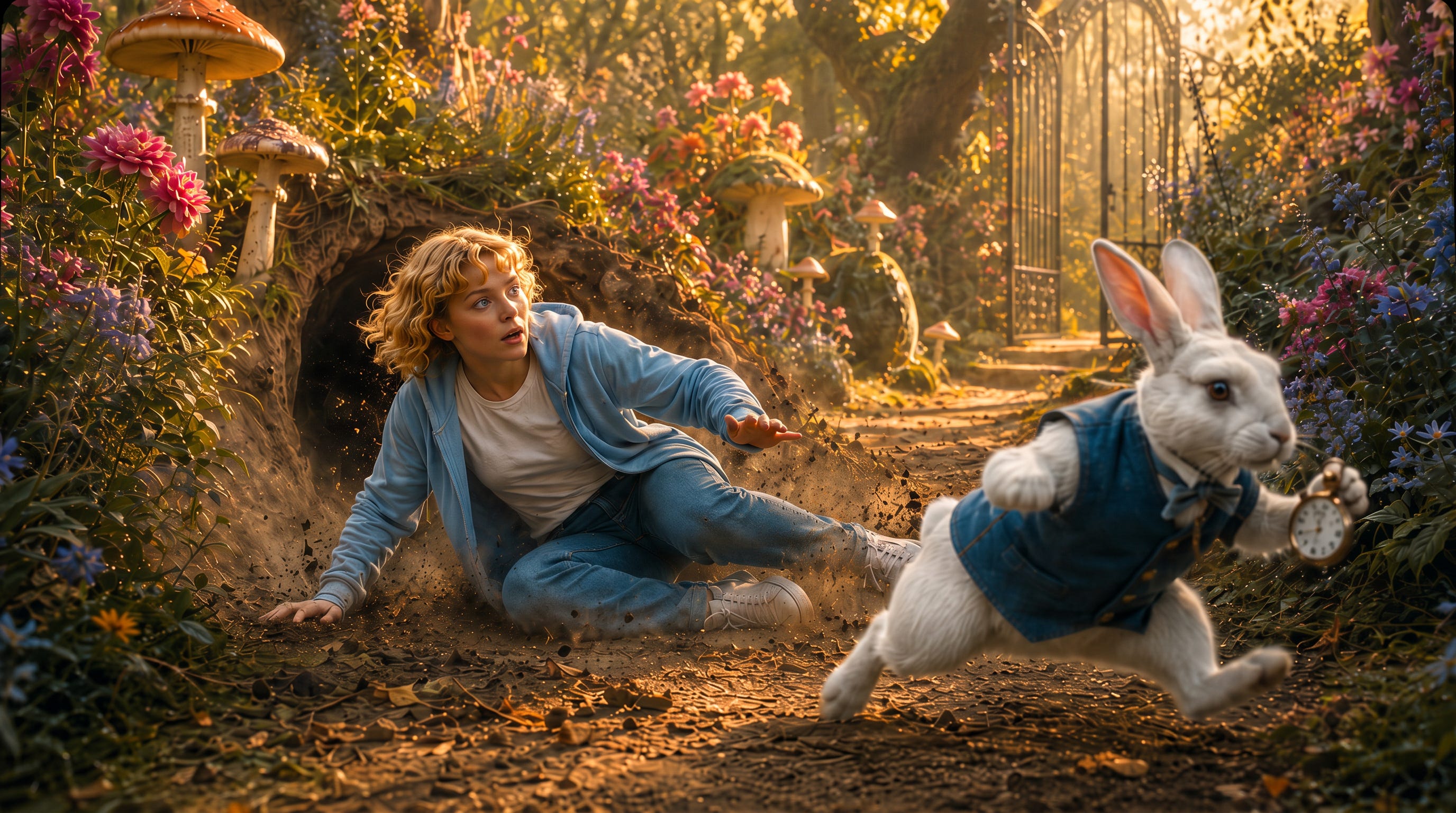
In November 1865, the first book about Alice’s adventures in Wonderland was published. That means it has been around 160 years since a mathematician who professionally played with logic and language invented this absurd world. An absurd world in which logic still exists. It simply belongs to the new environment.
In this environment, we meet a character who will go through almost everything the arrival of AI has brought us. The challenges, of course. But also the possibilities. Because in what other world can you suddenly fold up like a telescope and find yourself thinking:
I wish there were instructions for people who fold up like telescopes.
There are no instructions, of course.
But that does not stop Alice. Perhaps she is still too young and naive to fully understand which things are generally considered impossible. Or perhaps she possesses a rare ability:
when she enters an unfamiliar environment, she does not demand that it behave exactly like the one she has left behind.
When Alice finds a bottle labelled DRINK ME, she first checks whether the word “poison” appears anywhere on it. That is sensible. After a brief investigation, she takes a sip. And the world immediately becomes a little bigger. Or Alice becomes smaller. In Wonderland, those are almost the same thing.
Suddenly, she can pass through a door that seemed unreachable only moments ago. On another occasion, she grows so large that she begins to worry about her own feet. I do not think Alice was prepared for that. What saved her was curiosity.
The almost childlike curiosity that woke up in a great many perfectly grown adults when AI became widely available. Everyone received a bottle. It did not say DRINK ME. It said:
TRY ME.
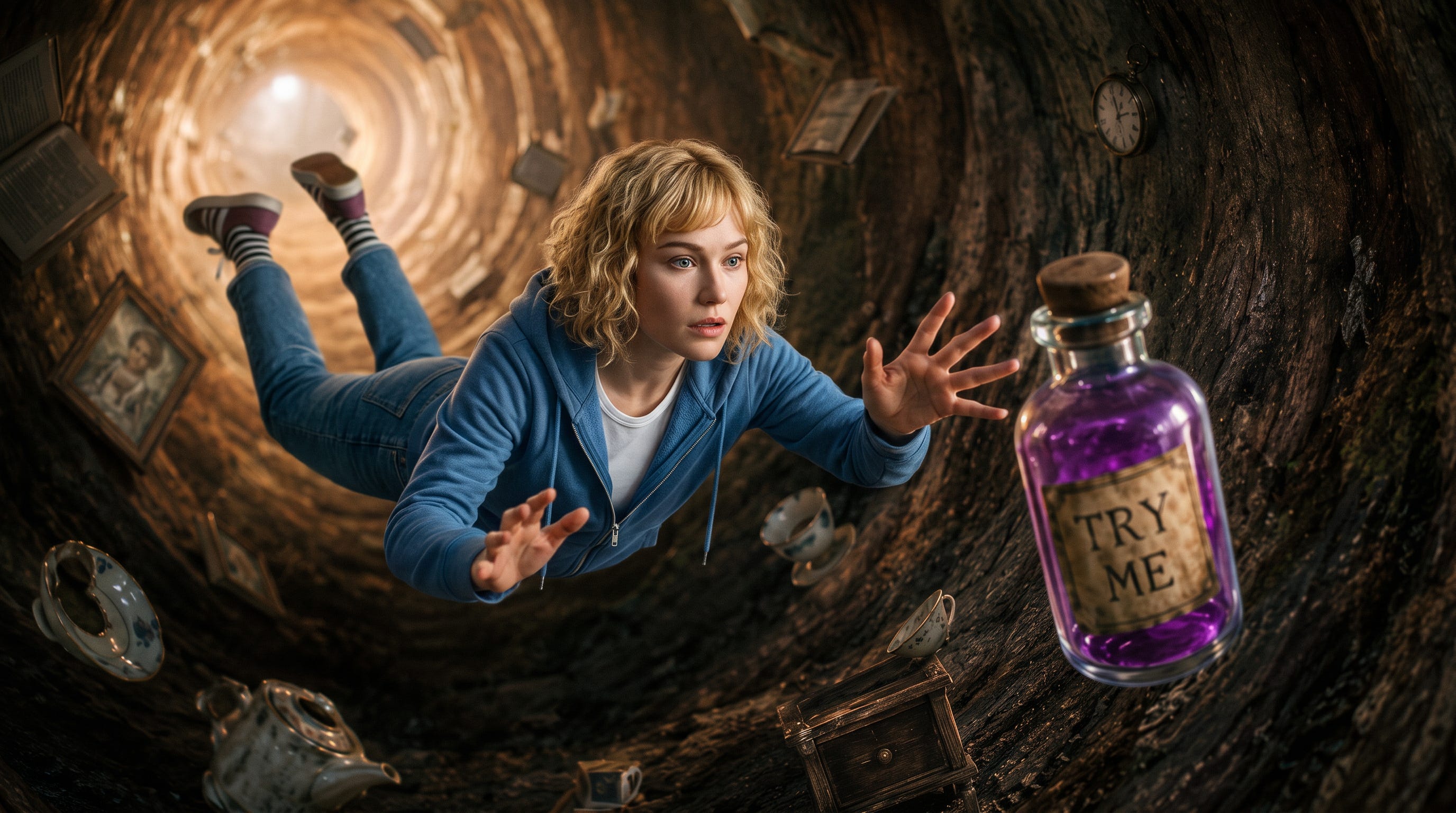
And regardless of whether you were seven, thirty-seven, or slightly older, there was suddenly an opportunity to fall into a new world and see what was waiting at the bottom.
There, a single sentence can produce an image. A question returns with an answer from a conversational partner who sounds as though it has read everything ever written, including books that have never existed.
Work that once took a week can sometimes be compressed into a few minutes. Curiously, after a while, even more work finds its way into the space that has been freed.
In Wonderland, changing size never solved a problem completely either. When Alice became small, she could no longer reach the key on the table. After the next transformation, the key was close enough, but the door was no longer suitable for a person of her new dimensions.
Every possibility opened a passage while creating another obstacle, usually one slightly more absurd than the last.
That is how an environment behaves when it has not yet acquired an instruction manual. The ability to create ten options in a minute sounds wonderful until someone has to decide which of them makes sense.
Eventually, Alice manages to return to approximately the right size.
In Wonderland, “approximately right” is already a serious achievement.
Not long after, she meets the Caterpillar.
Who are you?
he asks.
It should be an easy question. But Alice has already changed size so many times that she is no longer entirely certain.
I - I hardly know, sir, just at present,
she says.
This too feels familiar. The names of our roles may remain the same while the work inside them quietly changes shape.
A writer can generate without writing every sentence.
A designer can produce a working prototype without designing every screen.
A manager may find themselves coordinating not only people, but agents.
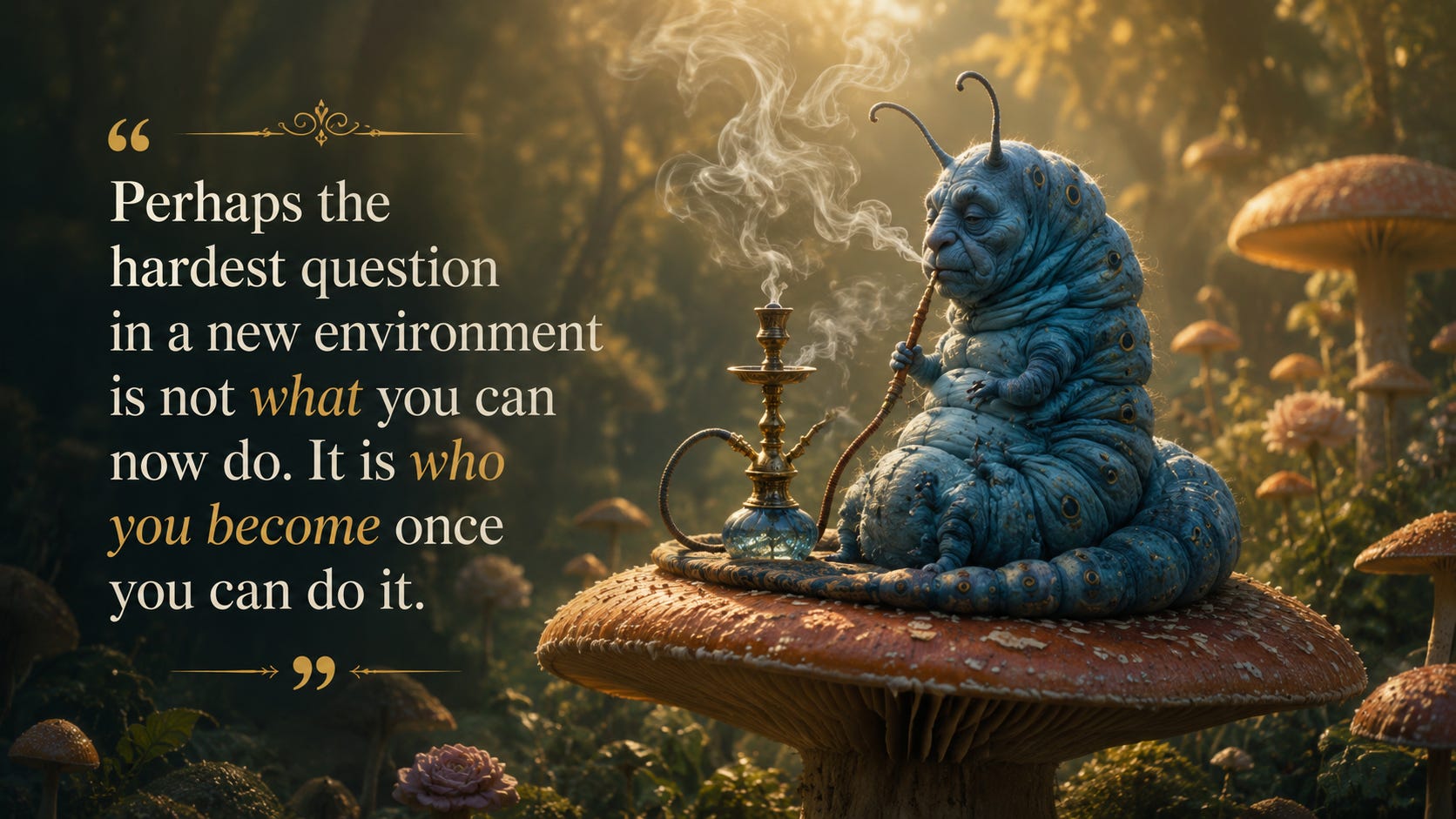
The title remains in place. The boundaries underneath it begin to move. Perhaps the hardest question in a new environment is not what you can now do. It is who you become once you can do it.
Somewhere after the pool of tears - the same one in which it is easy to find yourself when the new environment suddenly begins discussing whether it still has a place for you - Alice meets the Cheshire Cat.
He is ready to discuss roads, directions, and possible destinations even though Alice has not yet decided where she wants to go. In this respect, he is rather like a modern AI assistant. Both are happy to continue the conversation. Both can sound remarkably convincing. And neither suffers greatly when the original question disappears somewhere along the way.
Next comes a tea party that never ends. Everyone talks, changes the subject, and moves around the table. The conversation appears extraordinarily productive. It does not, however, lead to a result. There is something strangely familiar about this…
Later, Alice finds herself in court. The Knave of Hearts is accused of stealing some tarts. The jurors write down their own names so they will not forget them before the trial is over. The witnesses answer questions that have very little to do with the case. A letter without a signature, recipient, or comprehensible meaning is presented as evidence.
The King searches it for significance. And, naturally, he finds some. When a text is sufficiently unclear, almost anything can be discovered inside it. Eventually, the most efficient possible sequence is proposed: the sentence first, the jury’s decision afterwards.
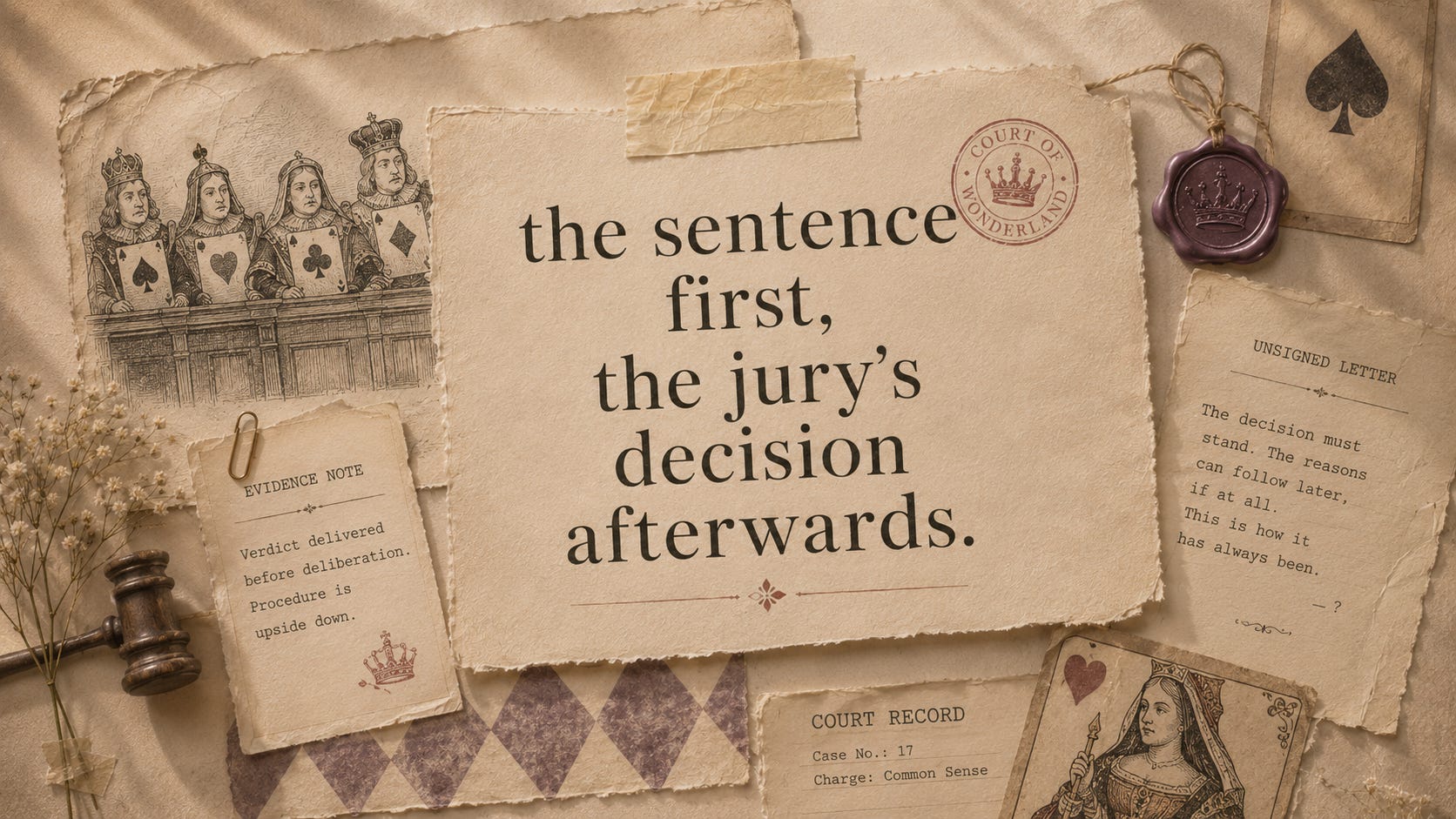
At this point, Wonderland stops feeling quite so distant. AI produces a convincing answer. The explanation can be requested later. Only afterwards does someone check whether sufficient grounds existed. Sometimes they did. Sometimes there is an unsigned letter in which everyone would very much like to find evidence. And sometimes the confidence of the answer begins to serve as evidence by itself.
By now, however, Alice is no longer the same small girl who fell down the rabbit hole. During the trial, she begins to grow again. At first, almost imperceptibly. Then she becomes large enough to stop being afraid of the cards. It's not the rules that became more logical. Alice has changed.
She has altered her size several times, become lost in conversations without conclusions, and watched an incomprehensible text transform into evidence simply because someone wanted badly enough to find evidence inside it. Statements that once sounded like the unquestionable laws of the new world no longer seem quite so absolute.
Alice looks at the court and finally says:
You’re nothing but a pack of cards.
Lewis Carroll could not have known about AI. But he certainly knew something about a world in which possibilities appear without instructions, scale changes, conversations continue without decisions, and confidence attempts to replace evidence. He knew something else too.
A new environment appears all-powerful until its rules are examined more closely.
What saved Alice was not learning every one of them. That was probably impossible anyway. What saved her was curiosity. She experimented, observed the consequences, argued with the rules, and occasionally admitted that she understood nothing at all.
Gradually, one thing became clear: the world had not lost its logic. The logic simply belonged to the environment, not to the person who had just entered it.
The bottle labelled TRY ME is still standing on the table. No one knows whether its contents will make a person larger, smaller, or simply produce several more options for a decision that still has not been made. But perhaps size is not the important part.
What matters, in my humble opinion, is noticing that this is no longer the same world.
And one day becoming large enough to look at its loudest rules and say:
You’re nothing but a pack of cards.
In Wonderland, a sentence could be passed before the evidence was considered. Our new environment has a sentence of its own - one whose meaning depends entirely on where the pause is placed.
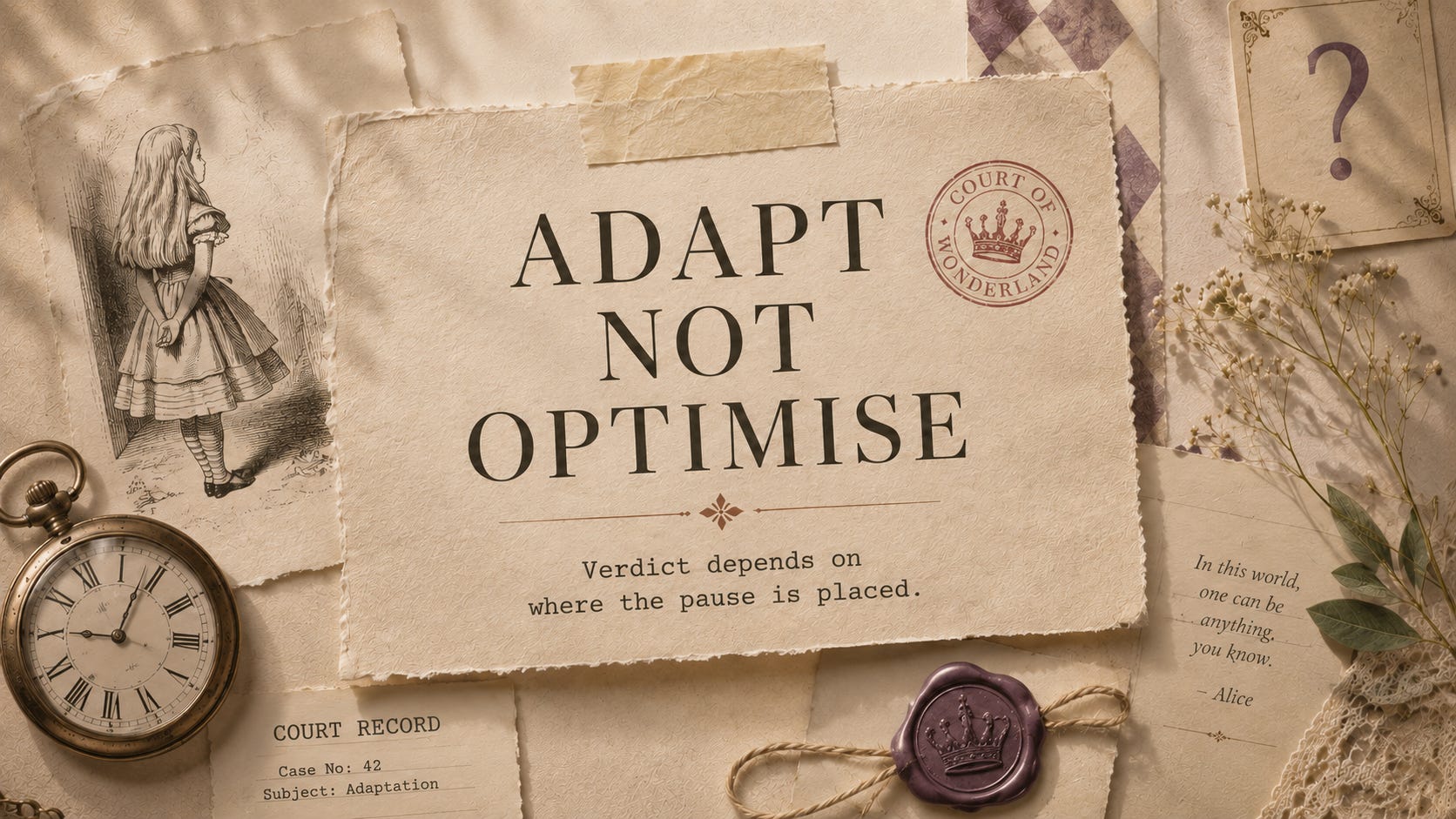
Adapt not. Optimise.
Do not change. Simply learn to perform the same work faster and more efficiently.
Or:
Adapt. Not optimise.
First, understand which world you have entered. Only then decide what is worth doing faster. The words remain the same. The sentence is entirely different. So the question is not whether a choice must be made. The question is where you will place the full stop.