


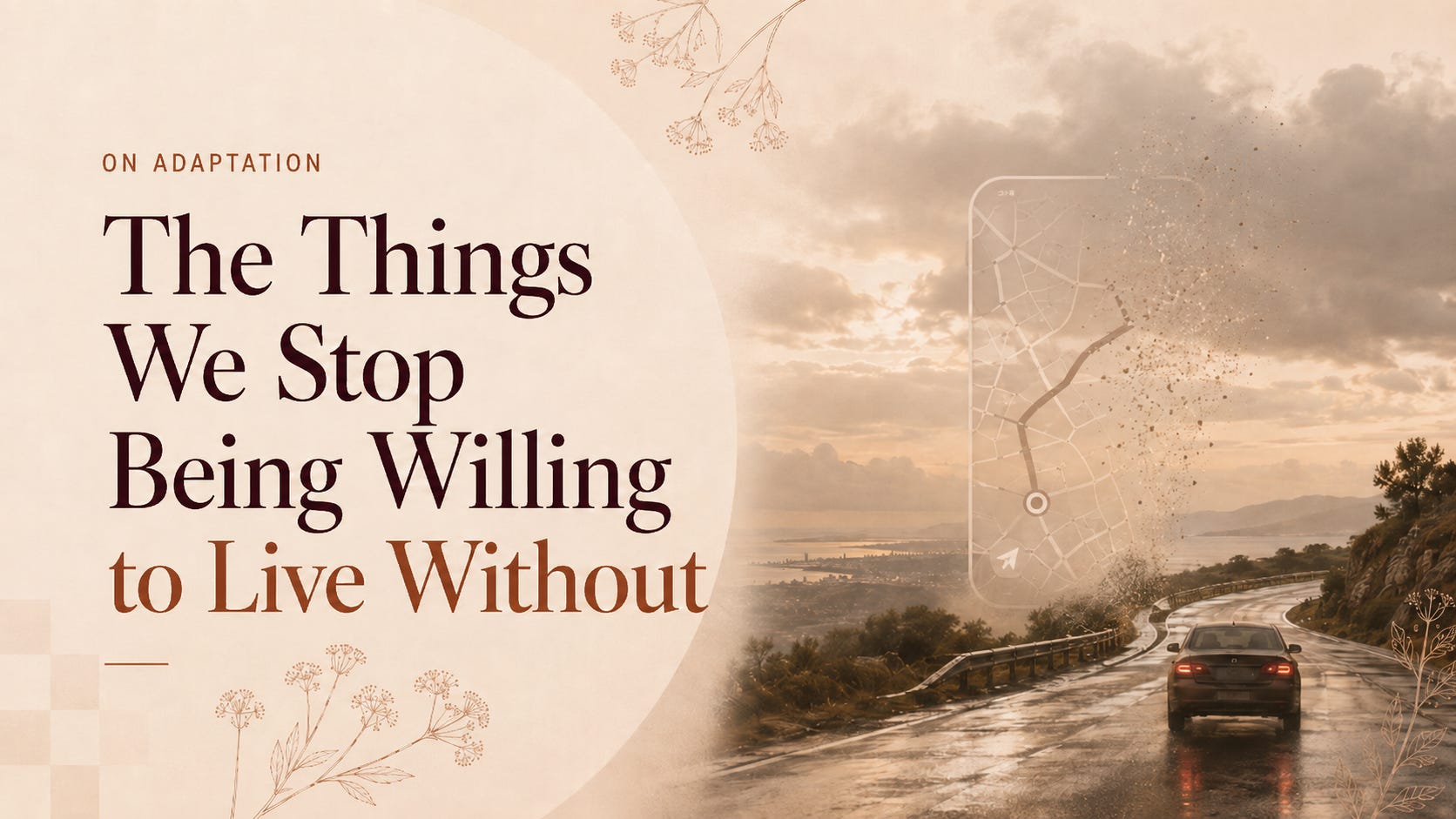
Yesterday, my mom’s flight from Budapest to Larnaca was diverted to Paphos because of heavy rain, a thunderstorm and a waterspout.
She had already spent around 40 extra minutes in turbulence, not knowing where the plane would eventually land, so when she arrived in Paphos I told her not to wait for the airline to organise a transfer.
Just take a taxi to Limassol.

At that point I thought she had had enough uncertainty for one day. What I did not expect was that the taxi driver would take her without actually knowing where he was going.
He had no navigation and no Wi-Fi, so at some point my mom called us and handed him the phone. My husband explained the area where we live and sent a location pin to my mom’s phone, assuming the driver would simply open it and follow the route. He never opened it.
I suspect he did not know how to use navigation at all. At one point he was also calling us while driving on the highway, but that is probably a separate story.
The whole situation got to me much more than I expected.
Later, when everyone was finally home and nothing terrible had actually happened, I kept thinking about my own reaction. Ten or fifteen years ago, the same taxi ride probably would not have felt nearly as alarming.
Someone gets into a taxi. The driver does not know the exact address. The passenger calls. Someone explains how to get there. That used to be normal.
Today, I expect something very different. I expect to know who the driver is and where the car is. I expect to see the route, the estimated arrival time, whether the car is moving in the right direction. I expect to send a location pin and assume the other person can use it.
These things have become so ordinary that I barely think of them as technology anymore. They are just part of how the world works. Until they disappear.
And I think this is one of the more interesting parts of adaptation. We usually notice the moment a new technology enters our lives. We notice the first time we use navigation instead of a paper map, the first time a taxi appears on a screen, the first time we can see someone moving towards us in real time.
What we notice much less is the moment all of this becomes expected. At some point, it stops feeling like an improvement. It becomes the baseline.
And once that happens, the old way of doing things can suddenly feel much harder than it ever did before. That is probably why yesterday felt like travelling 15 years back in time.
The situation itself was familiar in an old-fashioned way. What had changed was me. My expectations had already adapted to a different environment.
I spend a lot of time thinking about this in the context of products and AI. Right now, a lot of the conversation is still about adoption.
Who is using AI?
Which products have added it?
Where can a company introduce an AI feature?
But I think the more important shift will happen through expectations. People are getting used to software that can remember context, draft something instantly, summarise information, or remove parts of a workflow that used to be manual.
Once those experiences become common enough, they start changing how everything else feels. A product that repeatedly asks for information it could already know begins to feel unnecessarily demanding.
A workflow that requires five screens can start to feel strange once people get used to expressing intent directly.
Waiting days for a first draft feels different once creating one takes seconds.
Manual repetitive work feels more visible when we know a machine could probably take part of it away.
None of these changes happen because a user suddenly decides that every product needs AI. Expectations shift more quietly than that. People simply get used to a new level of convenience, context, speed or assistance somewhere else, and then carry that expectation with them.
That is why I keep coming back to the distinction between AI adoption and AI adaptation.
Adding AI changes the product. Adaptation starts when the environment around the product has changed enough that the old assumptions no longer hold.
Yesterday, a taxi ride made that idea unexpectedly tangible for me.
Ten or fifteen years ago, not knowing exactly where a taxi was would have been completely normal. Yesterday, the absence of that information felt deeply uncomfortable.
The world around me had changed gradually enough that I had stopped noticing what I now considered normal.
And I suspect AI will do the same thing to many more expectations over the next few years.
The most interesting question may not be what new things AI will allow us to do.
It may be what we will soon find surprisingly difficult to live without.