


“When I returned to the village, I couldn’t recognize a single thing. ... Everything was different.”
— Neungduangjai Sritrakarn
Survivor of the 2004 Indian Ocean tsunami, Ban Nam Khem, Thailand · Associated Press via GPB, 2024

For years, I heard the same answer from my clients to the first question I always ask when we start working together. When I asked why they came to me, the answer was: we want to scale or we want to grow. That answer started to change.
Now, more and more often, I hear AI adoption instead.
“Driven by a primal fear for survival I ran faster than I knew possible.”
— Tsunami survivor in Samoa
Personal account published in TsuInfo Alert following the 2009 Samoa tsunami · Washington State Department of Natural Resources, 2009
Deloitte found that 67% of surveyed organizations were increasing their investment in generative AI. By 2025, Microsoft’s Work Trend Index found that 81% of leaders expected AI agents to be moderately or extensively integrated into their company’s AI strategy within the following 12–18 months.1
At some point, I started wondering:
Have growth and scale stopped being relevant?
Of course not.
But when everyone starts running in the same direction, we all know what happens. Everyone runs, and somewhere along the way, we often forget why we started running in the first place.
While working on my book The Mutation Era, I came across the Red Queen concept in biology. I think that as we entered a new environment, we lost our reference point - growth and scale. After a tsunami, that often happens.
The Red Queen hypothesis
In evolutionary biology, the Red Queen hypothesis describes the idea that organisms have to keep evolving just to maintain their relative position, because everything around them is evolving too.
The name comes from Through the Looking-Glass, where Alice and the Red Queen have to keep running just to stay in the same place.
Something else that often happens is a loss of focus.Teams lost focus on who exactly they were making all these changes for.
But that’s only one side of the story. This tsunami didn’t hit only the teams. On the other shore, users saw everything with their own eyes.
“We didn’t know how big it was going to be.”
— John Henke
Tsunami survivor off the coast of Thailand · CNN, Anderson Cooper 360°, 2004
They had no idea how significant the changes in their own behaviour would become. While product teams were busy with AI adoption, users were reading tutorials, watching YouTube videos, and simply experimenting with AI. So much so that now they expect products to let them delegate their tasks.
Not just to have AI somewhere in the core functionality. Not AI that justifies a higher subscription price. But the actual ability to delegate their tasks.
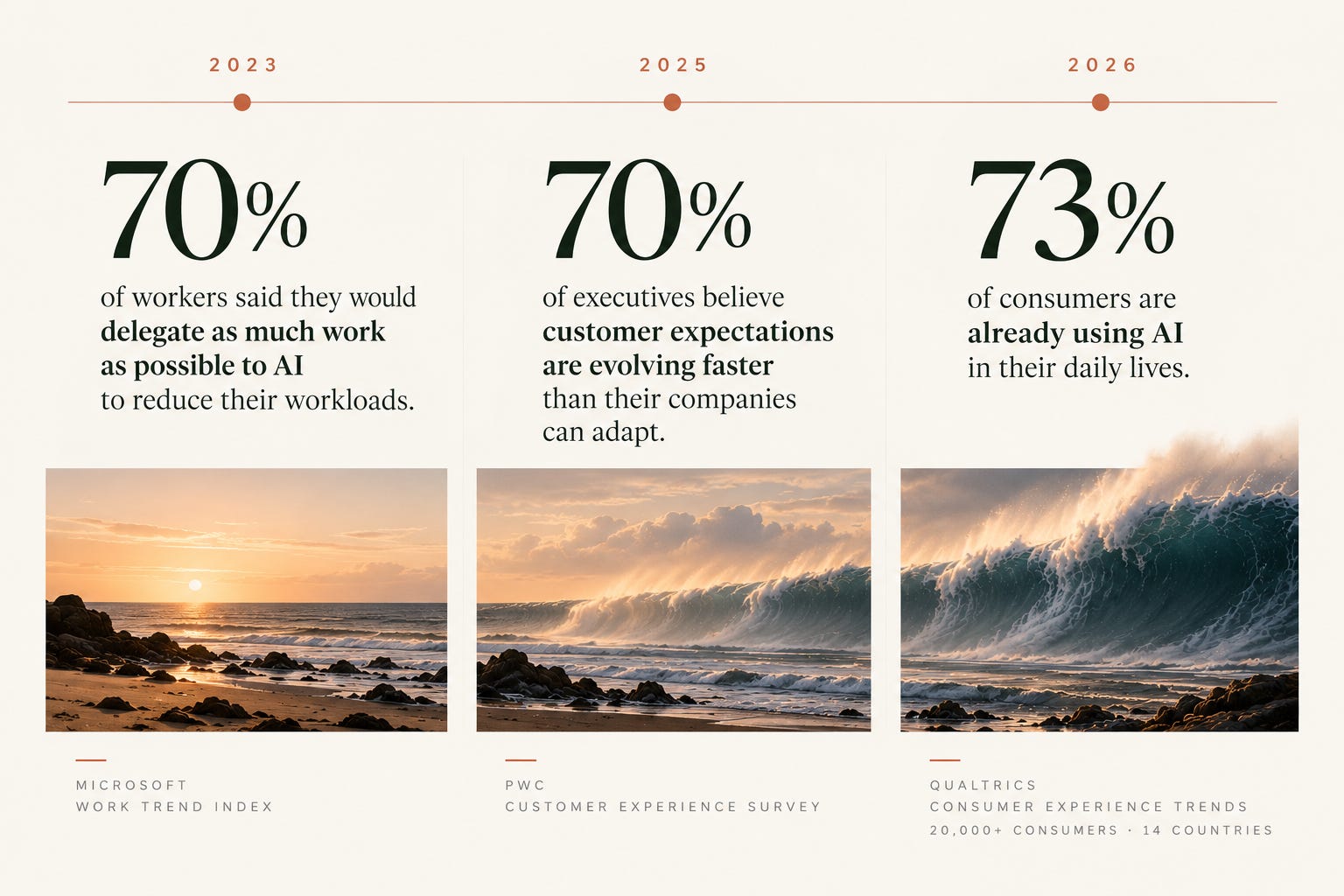
Meanwhile today, in coworking spaces around all over the world - and I suspect far beyond those 14 countries - you can increasingly hear:
GO AWAY AI
And that would be in CAPS LOCK, because people are screaming at their screens without hesitation.
They know the person sitting next to them will understand.
PwC found something else too: 58% of consumers said they were only somewhat comfortable or not comfortable at all using AI tools to engage with brands.2*
So now we have AI.
But users aren’t happy.
Something in this story went wrong.
My theory is that we missed one very important thing:
What exactly users want to delegate to AI, to what extent, and how - when it comes to the things they currently do themselves.
Delegation.
Remember those memes from the early days of widespread AI adoption, where people were saying: I don’t want AI to write, design, or do something else for me - let it cook dinner.
That’s the whole point.
I think product teams need to stop for a moment. Although, of course, now that everyone has picked up this much speed, that won’t be easy. But when we do stop, we need to look around our village and go to our neighbours on the other shore - the users.
Apologise, the way children apologise after refusing to play with someone at kindergarten. We need to admit that no matter how many new technologies appear and how much our processes change, user expectations still need to guide us. And only then ask them a few simple questions about delegation.
This is a question of survival - both for us as product teams and for our users.
Optimise, in this case, means continuing to add AI that nobody is using.
Adapt means finding out what users want to delegate, how they want to delegate it, and how much control they want to keep over each particular task.
Sources
Deloitte — State of Generative AI in the Enterprise, Q3
67% of surveyed organizations were increasing their investment in generative AI.
Read the report
Microsoft — 2025 Work Trend Index
81% of leaders expected AI agents to be moderately or extensively integrated into their company’s AI strategy within the following 12–18 months.
Read the report
Microsoft — 2023 Work Trend Index
70% of workers said they would delegate as much work as possible to AI to reduce their workloads.
Read the report
PwC — 2025 Customer Experience Survey
70% of executives said customer expectations were evolving faster than their companies could adapt. The same research found that 58% of consumers were only somewhat comfortable or not comfortable at all using AI tools to engage with brands.
Read the report
Qualtrics — 2026 Consumer Experience Trends
Based on more than 20,000 consumers across 14 countries, 73% of consumers reported already using AI in their daily lives.
Read the report